

From the desk of Daniel “Pinecone” Verona.
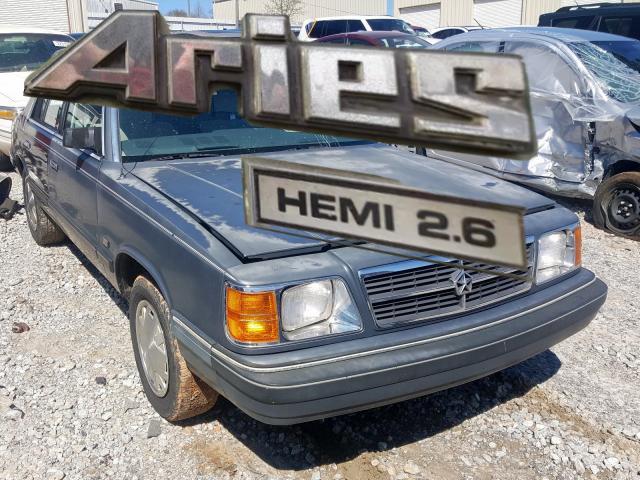
Yeah, that’s a Dodge HEMI badge, and you’re probably wondering how it ended up in this situation. Let’s investigate.
I wouldn’t blame you for falling into the same pit as myself, slinging doubt and humor at the idea of a K Car with an engine badge reserved for muscle icons. But as with many marketing decisions, we often think more reasonably than those who made them in the first place. The HEMI K Car is automotive canon, and I’m dragging you into it with me.
The car above is a Dodge Aries, but we both know it’s also a Plymouth Reliant. Badging is irrelevant between them. Both are vanilla and sawdust flavored FWD compact sedans from the defining “let’s just let the heat die down” malaise era of Chrysler. I’m partial to the K Cars, but they lack the quirkiness of the comparable GM J-body that serves as the only reason I would own one of these ill-maintained rolling cubicles. The GLH Shelby hatchbacks were among these cars’ only forays into the performance world, using the later 2.2 and 2.5 Chrysler turbo engines. These machines made their well earned marks on history, but the story turns strange when other legendary badges end up on models with all the.

No, HEMI doesn’t always mean Nascar, and this 2.6L unit is, unfortunately, not a miniscule V8 with a sky-high redline. Gaze beneath the rusting hood of your Dodge Aries and behold the Mitsubishi G54B’s American stepbrother.
Oh wait that’s a turbo Starion engine!
No, it isn’t a turbo Starion engine. It remains a 2.6L SOHC inline-4, and is rooted in the same family, but the unit has been thoroughly Americanized and is no better for it. Horsepower in the mid 200s? You get 96. Port fuel injection with charge cooling? Meet the 2-barrel carburetor, or throttle body injection if you get lucky. It’s like doing a full-bolt-on build but in the opposite direction.
Anyway, back to the HEMI, how it is, and where it is.

Take a look at the cylinder head I just unbolted from your car (no, I will not put it back). At a glance it is easily mistaken for a proper V8 unit, but note the overhead cam tunnel and lack of pushrod passages. The overhead cam HEMI head is not unique to this engine, seeing widespread use in Jaguars, Alfa Romeos, and Ford’s notorious “cammer” 427 stateside. There is a notable difference in brand ethos when this design is applied to a Dodge in particular, but we will get into that later. Take another look up close, and this cylinder head hides one (1) truly unique feature among similar designs.

Refer to this figure in your textbook. Here we have the intake and exhaust valves of one cylinder on the mighty 2.6 HEMI. Note that on the intake rocker there is a strange extra “ear” on the casting, pressing on a third, smaller spring. This “jet valve” or “MCA system” is a sort of secondary intake valve, a design similar to Honda’s CVCC system that promotes combustion swirl. As for how well it worked, I would say the delete kits available online tell the story well enough.
To understand the confusion all this creates in the first place, we have to look at what this badge means to Dodge in particular. As mentioned, the hemispherical cylinder head and its benefits have been widely used in engine design, but Dodge was the one who made it mean something. After the original HEMI V8’s debut in the late 50s, the term was no longer just a configuration, it had an appearance, an ethos, a sound, and a feeling. It was the engine that destroyed its opponents in every contest it entered, and its soul belonged to Dodge.
Every time you see someone drop $60k on a decade-old overpowered sedan built from the Mercedes parts bin, remember why they did it.
That front fender says HEMI on it, and they are going to let everybody know.
So then, sometime in the 1980s, Dodge realized that their tech-trade deal with Mitsubishi had returned a familiar design, and those with the power to step on designers’ toes had as good an idea as ever. All those whose younger years were defined by the brutal performance of the 426 street HEMI would be shuffling into their local DodgeChryslerPlymouth dealership, ready to settle down with a vehicle as inoffensive as their political opinions. And perhaps, examining the rear bumper, they will dash for their check book at the sight of such a nostalgic name. The hood of this car will never be opened, except by that same dealer, until the car’s job is done.
In essence, this is the automotive equivalent of using black truffle and Cora vermouth to season a freezer-burned round eye steak. And that, with some extra details, is how a HEMI badge ended up on a K Car.
Leave a Reply