

As we all await the hotly anticipated “5 More Engines Ever Made”, I have found myself thinking more deeply about these pieces of machinery in the past week. After falling down various internet rabbit holes and consulting my own engine encyclopedia, there’s an interesting topic among automotive engineering to look into here.
Designers love the aesthetic experience, engineers love a perfected mechanism, and the finance team loves making sure neither of them get free reign. This effect is often clearest in the automotive industry, and leads to some interesting compromises with, sometimes, legendary results. This week, let’s take a look at five modular motors that were thrown together from others.
GM 4.3L V6

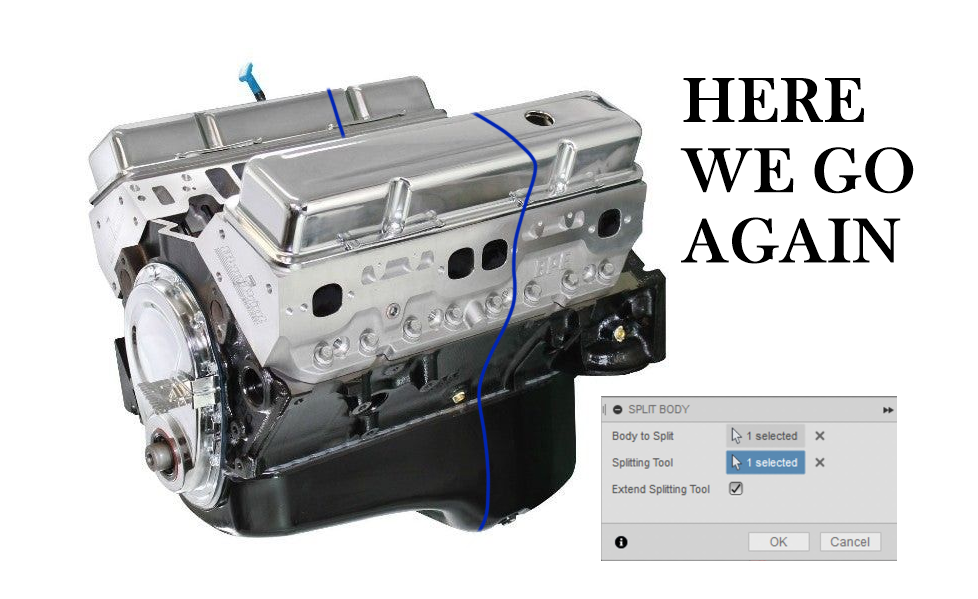
I will defend this unremarkable slab of iron until the end of my days. The 4.3 is, without exaggeration, a GM 5.3L (327) V8 with its front two cylinders chopped off. Feel free to check the intake and exhaust ports for verification. Because of this, and unlike many other V6s, it has a 90° vee angle and was mainly used as a smaller V8-alternative for vans and trucks. This made the 4.3s exist largely unnoticed, ever idling in the background under the hood of some ailing Express van. However, these engines did get their 15 minutes (or rather two years) of fame, when they were turbocharged to 280 HP in the supercar-killing GMC Syclone and Typhoon. As a testament to their durability and potential, the 4.3 line lives on today as an LS/LT based engine.
Aston Martin 6.0L V12

It can be said with confidence that no single manufacturer is responsible for Aston’s modern V12. But to begin, we have to talk about Ford. There is a reason that the mid-2000s Ford Fusion looks so similar to the British sports cars, but I’ll leave that connection for you to unravel. Yes, the two were partners at the time, and Aston needed a big fancy engine for their big fancy richboy toys. Ford, Mazda, and sometimes Kia, had a certain excellent V6 (known as the 3.0 Duratec) that Porsche had helped them make a few years prior. This powerplant also found itself in the exceptionally special Noble M400 with a pair of turbos. So Ford, being the cost-cutting geniuses they are, merged two Duratec blocks into a “new” quad-cam 6.0L (actually 5.9L) V12, pat themselves on the back, and left. This engine lives on today with two turbochargers and a legacy of its own.
Detroit Diesel 16V92

We just have to start with the specs here.
This is a 24.1L 2-stroke diesel V16 with twin cams, twin blowers, and sometimes twin or quad turbochargers. It weighs around three tons, produces up to 1400 HP, and consumes an ungodly amount of fuel at any speed. If you have not heard one of these behemoths run at full power, open a tab in YouTube right now, please, it’s for your health.
Good, now that that’s out of the way, we can investigate it. Detroit Diesel’s greasy old 2-strokes were a modular line spanning a few decades. There were inline and vee engines of the series 51, 53, 71, 92, and 149 (cubic inches per cylinder). You may notice this industrial V16 has dual valve covers per bank, though many other things on this engine come in pairs. The 16V92 is quite literally made from joining two blocks of the more-common 8V92 (12.0L V8) in a single casting. The same could be done to create a larger V12 or V24 (which does exist), but that is a story for another time.
Deutz Series 912

Similar to the previous entry, Deutz manufactured a modular line of engines for their Tractors, Magirus trucks, and a wide variety of industrial doohickeys. But unlike the Detroits, these units were 4-stroke air cooled diesels with individual, modular cylinders that can be removed and swapped. Most were naturally aspirated, some turbocharged, and this line spanned all the way from a single cylinder unit to a massive, intercooled, twin turbo V12. Pictured above is the odball 5-cylinder of the bunch, labeled the F5L912. Most engines in this lineage are very simple and understressed, as this 4.7L unit produces only 91 HP without a turbocharger. However, they are extremely stout engines, popular in tractor pulling for their immense tuning potential and comparatively low weight.
Ford 6.8L V10

Not to get controversial, but we need to mention the ford Tritons. The series of Ford engines equally loved for their variety and tuning capability, and hated for their ability to break parts never before thought possible.
Look up the spark plug issues.
However, that was the V8. This is the 6.8L Triton V10, which added two extra cylinders to the venerable 5.4L “3-valve” unit found in various trucks, which served as the deeply-flawed bigger brother to the Mustang’s 3V 4.6. Starting in 1997, Ford managed to produce the world’s blandest V10 which we see here. It was, and is, essentially a gas engine to do the job of a diesel. It revs about as high, and makes 460 lb/ft of torque for its 360 HP. The 6.8 is the engine for the Excursion, Super Duty, bus, or van owner who doesn’t want to pay for diesel. It’s not an engine you tune, it just pulls heavy things and does so without much drama. I find myself charmed by this unit’s utilitarian nature, with a bit of nostalgia mixed in. I sure won’t complain that the school buses of my childhood sounded like Vipers.
Leave a Reply to The Best Trucks For YOUR Budget In 2023 – Mis-shift into my assCancel reply