

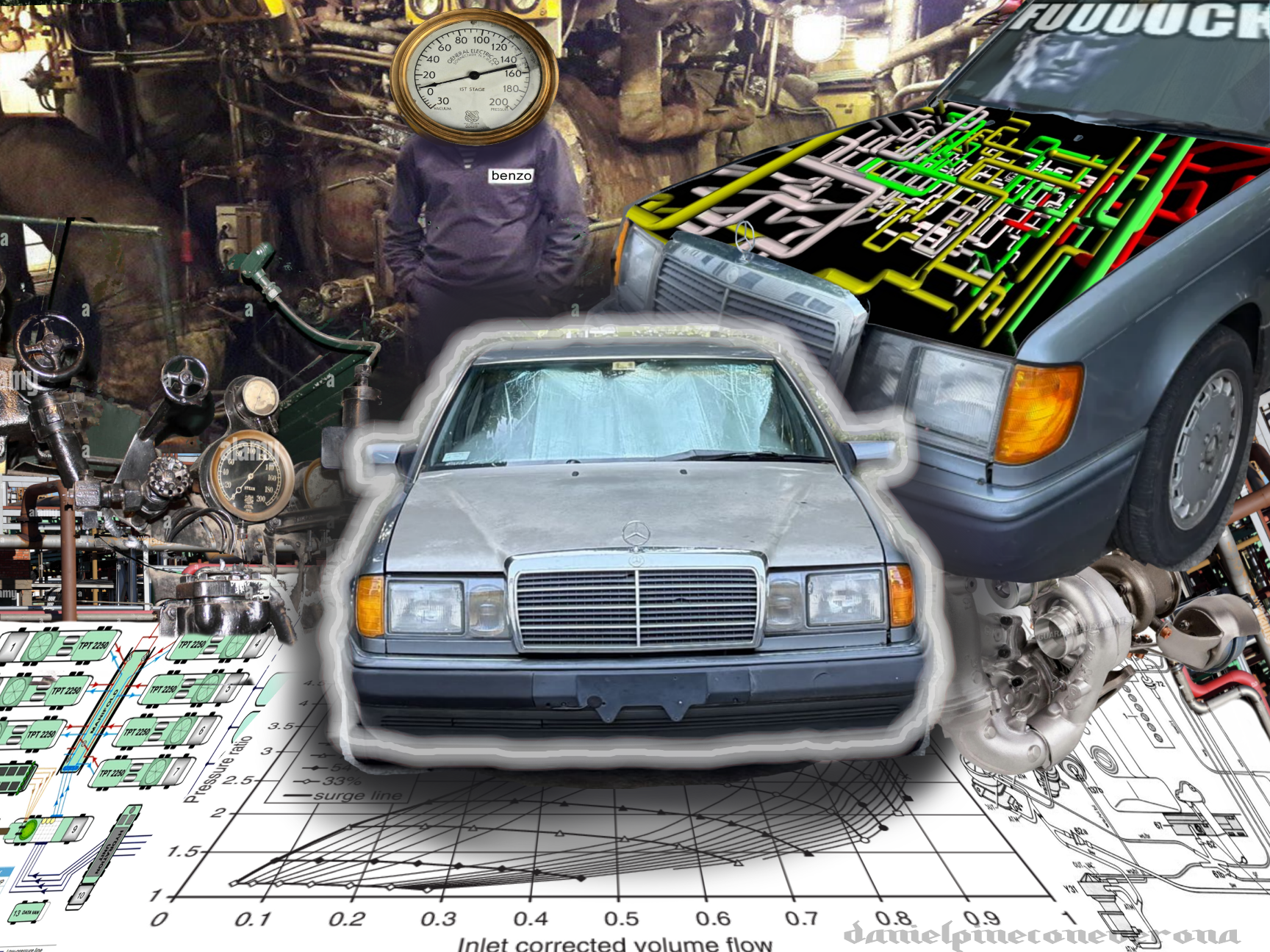
Well you see when I bought the Benz I had been fooled, somehow the car had no turbo pressure, but in the flatlands while dodging hit and runs in Savannah, GA, the Mercedes had fooled me. It was not working right. The car had managed in some way to figure out how to run, quite well, at 0 psi. The issue with that is that the mountains will reveal said flaws… so will the system being upset by a collision. Both resulted in a feeling of hmmmmmm this car is slow, but it should be faster than that.
Well I took it out to the woods and on a very unoffical test ground found that it layed down a 22 second 0-60. Absolutley diabolical, yet somehow, American drivers, specifically the old and the ones from flatlands are so bad that they managed to hold up my benz, going uphill, at multiple points on my way up to asheville to get myself a new hood (from our resident pimp master and his absolutley clapped 400E).

You see, the turbo system on the Benz is a fully vacuum operated system. Springs? Nope, everything is controlled by vacuum lines. And yes that includes the wastegate, which of course, is also vacuum operated. Does this system work? No. Does it make sense? Only in theory. Does the car now make boost above 0 psi? Yes. Well lets figure out how in the hell we got there. And of course it involves unplugging emissions features that I do not comprehend. Later said emissions feature got plugged back in after I noticed it to have no ill effects (seemingly) Shown below is the quality you send to get from 20 year old forum posts:

Good thing we have the loyal $15 homemade smoke machine in order to help us!

Step one in this process, as per most German cars are is to remove everything. In theory, the exhaust comes apart. In rust, the exhaust does not come apart. So rather than fight a war of liquid red cancer (ATF mixed with acetone), its easier to simply remove the engine mount (two bolts and an extension train) than it was to free whatever was bonding the exhaust together. With the engine tilted a few inches out of the way, and many of the weak old hardware turned into flatheads by the Dremel, the system that allegedly is supposed ot make boost now lies in front of us. Behold an exhaust and induction system courtesy of the fatherland:

Lo and behold, the wastgate had a solid 180 degrees of play and was just rattling in place. That certainly would be a reason to not have any form of boost pressure. The wastegate in this car is not controlled by a spring like in any normal car, its controlled by yet another vacuum system. You see on your standard turbocharged car you have a spring, on this car, you have a vacuum tube to pull the wastegate open when it needs to be open, and then as this vacuum bleeds away, the wasetgate closes and allows the turbo to attempt to build boost again. While in there, I also raided the McMaster Carr parts catalog in order to find similarly sized vacuum lines… because I have already used all 6 of the feet of vacuum line that I ordered…


So after digging in and playing with all of these different transducers we found out some more fun facts about this wonderful machine. There was still no boost so we ordered a very very functional amazon boost gauge. (it reads -10mm/Hg when the engine is off, so needless to say I dont think it can actually be trusted). So after re-assembling everything there’s still no boost, and well, after unplugging some random sensors while at a friend’s graduation party we acheived a massive goal: the long sought after positive manifold pressure!
Afterwards we hit up the local woods to do some verification testing. With a gps speedo in one hand and a timer app in the other, the newly boosted rocketship laid some 15 second runs! Not too bad considering the best it had to offer from the factory was 12.5. And very, very good considering the last it was able to do was a horrid 22-25 seconds. With the Benz able to keep pace with standard traffic, the project now moves on.
Leave a Reply