

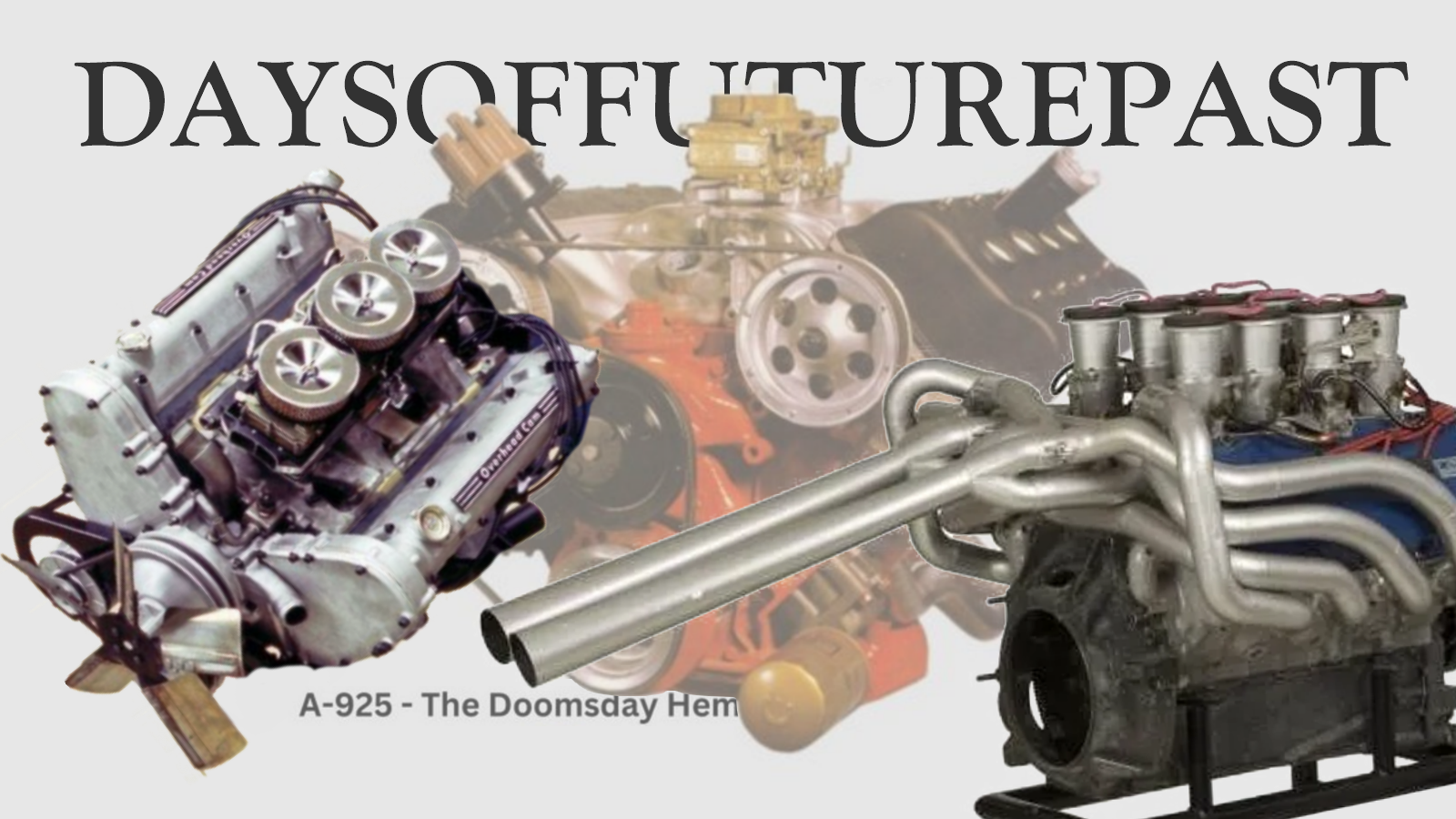
Cammer? Isn’t that one of those ladies that take internet videos of their feet?
Well…yes I suppose so, but that’s beside the point. Take your meds.
We have spoken before on forgotten engines from American history, even if sometimes they are Japanese. But this remains one of my favorite topics to info dump – lecture – about, and you have once again stumbled into my class. Sit down, stay awhile, act occupied while your boss chews out your coworker for reading fanfics on the company computer.
More than 50 years ago, the big three and their associates had layers of plans cooked up for ultra-performance multi-cam V8 engine platforms, the likes of which are barely being matched by today’s offerings. Namely Ford’s Coyote and GM’s LT6 Z06 engine. Most of these operations were strangled to death by Nascar and FIA regulations, or the very financiers that originally backed them. Sometimes it be ya own homies.
Today, let’s talk about three of these prehistoric monsters.
The Calliope

First contender into the ring, in no particular order, is the blue oval.
The term “cammer”, as used above, was originally coined with Ford’s monstrous 427 SOHC, a Nascar outlaw engine that the well learned among you may already be familiar with. That concept appeared in 1964 to combat Mopar’s 426 HEMI, and served as a stepping stone into far less known overhead cam experiments. But unlike the OG Cammer, the Calliope was built for the long haul. The 427 FE engine block is a recurring character in these stories, dominating Nascar for years and bringing Ford to Le Mans victory in 1966. This unique design was to be the next step in that story.
Unlike every other pushrod V8 (as far as we know), this engine used two camshafts in the center of the block valley, one above the other. In the photo above, you can see them stacked exhaust-over-intake. These allowed for varied pushrod angles, to operate 3 valves per cylinder in a “semi hemi” head. These and the engine block both appear to be aluminum. With that many valves, cavernous intake runners, and an ornate set of headers, it is rumored to produce 630 HP in endurance trim. We can only imagine what sounds this 7 liter unit would have produced, and what offspring it might have aided in development.
As we know, the 3-valve Ford would reappear in the early 2000s, though far less impressive in the form of a small block spark plug cannon.
The DOOMSDAY HEMI
As a self-diagnosed HEMI fan and Mopar apologist, this is a contraption of great interest to me. Long rumored about by lawn chair historians, they won me over, and I was plunged into my own research soon enough.
What we see here is the mythic A925. The Mopar pentroof. The DOOMSDAY HEMI.
It has quite a list of specs to go though, so lets get this straight. The A925 uses the same block as the race-spec 426, with the same displacement at 7.0L. Those two massive pulleys on the front end are geared to quad overhead cams operating all 32 valves. Strangely, this iron block engine was adorned with magnesium heads and a 16-port intake of the same material. As opposed to a conventional HEMI, this unit used a more angular “pent roof” head design to accommodate the side-by-side valves at an angle.
So is it a “true” HEMI head? No, but neither are the new ones. Shut up.
All numbers are left to estimate and speculation, but documents claim a mighty 750 HP north of 7,500 RPM. She spins quick for a big motor, but the theoretical limit? 10,000.
And perhaps the most special detail of its inception is that one example still exists. None seem to know when it was last run, if at all. This story also begins in 1964, with Ford’s aforementioned 427 cammer. With the original 426 HEMI already in production for Nascar, the Mopar boys set out to obliterate Ford’s efforts from the get-go. A doomsday device, so to say. But this story ends swiftly, and in a similar way to most as-advanced engines of its day. The suits swept in and shut down the potential of “exotic” engines in the series, killing the Ford cammer before the A925 had been tested, effectively removing it’s raison d’être and any chance for it to compete.
It was left as a Joker without its Batman. But to this day, the multimetal beast lies in rest in some obscure storage facility. Waiting, I hope, to be reassembled and some day show the world what peak performance could have been.
The McKellar Mystery Motor

Pontiac, gobbless ’em, had more feet in the door than other companies when it came to overhead-cam designs. An unnatural, inhuman amount of feet.
Most of these projects were overseen by GM’s Mac McKellar, a serious Zora-type innovator in the engine department at PMD. Starting around 1963, he led a number of new-platform projects wild enough to deserve their own articles. A quad cam V8 fit for indy, a unique unequal 3-valve design, and numerous other wacky designs you can look up after class. Put your phone away until the bell, please?
The most known result of these endeavors was the infamous (?) OHC-6. An iron-aluminum inline unit mass produced from ’66-’69 in Tempest coupes. A decently performing base model engine with fully unobtanium parts in the modern age. One of McKellar’s experiments was to expand on the OHC head design, shortening them and fitting two to a 421 V8 block. The relative simplicity of these heads, similar to the- Ford 2V 4.6 – made this design far more appealing for production than other race-ready ventures.
Considering the very healthy 405 HP of the stock 421 engine, we can estimate with a high degree of scientificism that the OHC would make closer to 450 with Tri Power carburetors and other niceties. McKellar would install one of these engines into his personal Pontiac Grand Prix. It is a stock looking car, but as if from another, radder timeline.
. . .
Americans would not see another high-performance multi-cam V8 for nearly 30 years, when Lotus blessed us with the heart of the ZR1 Corvette.
But remember these stories, and know what could have been.
Share this post with your friends to mis-shift into their asses too!
Leave a Reply