

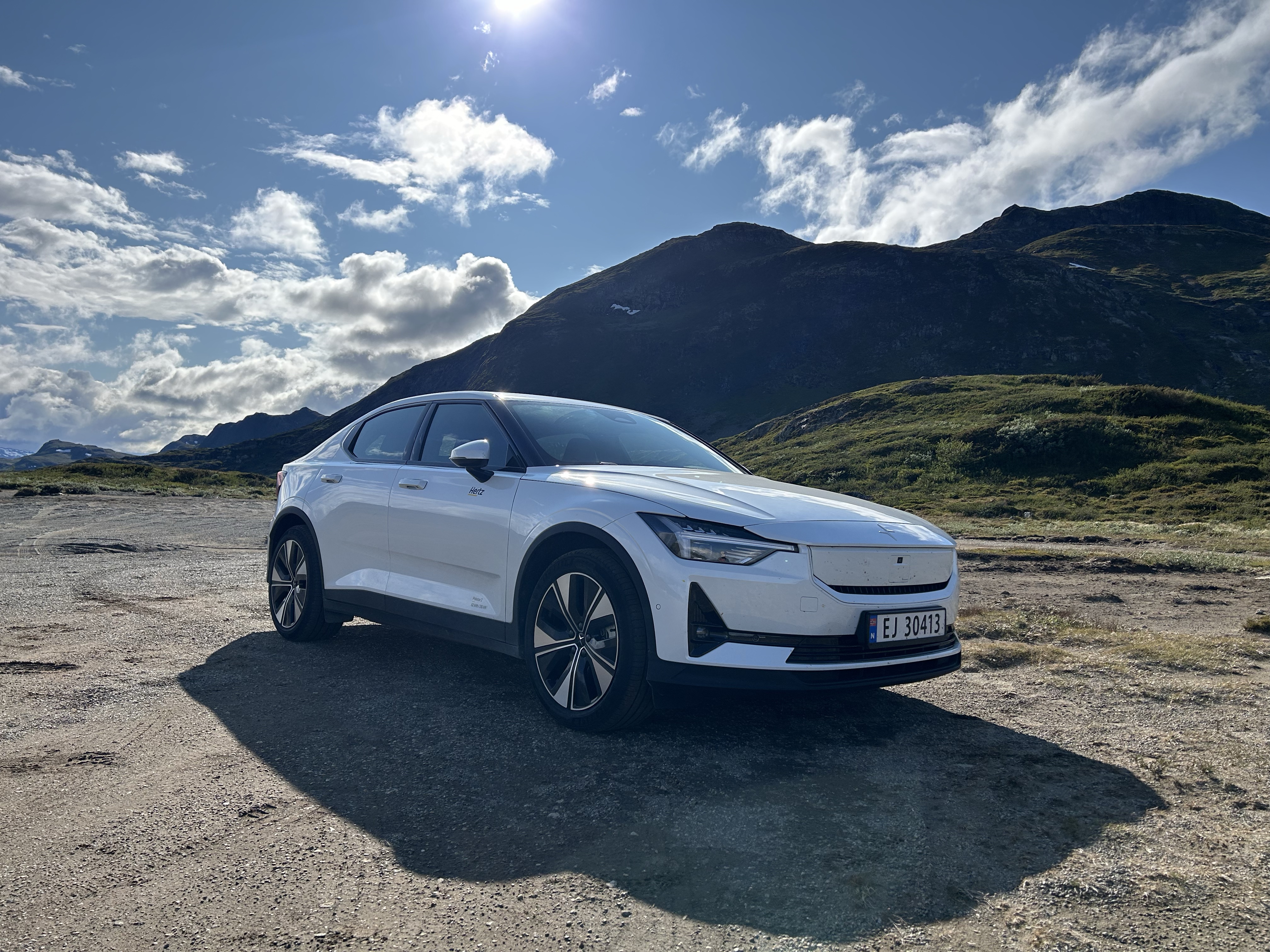
I THOUGHT YOU WHERE SUPPOSED TO MAKE ME FEEL NUMB!

I had this Swedish-Chinese chimera in sedan form for a week in Norway. So, not only did I get to fuck around with a Polestar 2, but it was a nifty little trial run for the “EV Lyfe”. And what better place to try all that out than a country with fast chargers in seemingly every other small middle-of-bum-fuck town.
So, batten down your arses, ye scallywaggs, it’s Polestar time.

Imma slap you with the stats like a halibut to the face. They aren’t the important bit.
The cars weighs some 47000 lbs (~2125 kg), with 420hp and 564 ft-lb (740 N-m) of torque to move all that mass. It has a 78 kw/h battery, AWD from one motor at either end of the car, and a range of over 550 km (340 miles) according to itself. Will it do 550 km? With me it did more like 460 with AC, heated seats, four passengers and their luggage, a bit of spirited driving, and charging it with typically 50-100 km still within its range estimates.

“BUT MONTY!”, you shout into the void, “THATS A BIG DIFFERENCE!!! THOSE LYING GLOBALIST-”
Shhhhhh hush now.
Come here.
Come closer
Maybe it could do over 500 km on a single charge. Maybe we could’ve been more mindful of the battery a bit. I don’t care. Whatever mileage (or uh… kilometer-age) we got outta that thing between charges was more than enough for the road trip between just south of Oslo, somewhere way in the north and isolated, and then back down to just north Oslo. Without stress either.
“OH BUT MONTY”, you shout, once again into the void, “YOU MUST CHANGE YOUR LIFESTYLE, YOU SUBMIT TO THEIR TYRANICA-”
Shhhhhhhhhhhutthefuckup. I’ll get to all that later. Let’s just go drive this thing together shall we?
Come with me. Let’s us walk up to the car:

The 2 looks a bit odd in my eyes. Well styled in a Volvo kinda way, but it’s not a Volvo. It’s some weird third option that smells and tastes funny. And it’s oddly blocky, unlike its very rounded California made competitor. The car seems to also sit a bit tall, but maybe that’s just me. The front end does away with the blacked out grill from other years. Instead, the front of this car is a monolith of chiseled white plastic and sensors. While the front fascia might look a bit odd now, it does nudge the car away from its Volvo origins a little bit. Though looking at its head and taillights, you can still see the 2 has its mother’s eyes.

Stepping inside, you’re greeted with another somewhat puzzling interior. My eyes tell me it’s well styled. The materials look interesting, color, material, and texture all change around the dash and door cards keeping your mind somewhat invested. It looks well designed and modern. This feels 2024/25 in here, unlike some other cars…

And then, like that Alfa Romeo Gulia from last year, you then start touching things. Suddenly you feel cloth, something that feels like canvas, and a lot of misc plastic. It’s not as cheap feeling like that Alfa. No buttons pop out, nothing rattles around like in the Ford Edge. It’s not low rent. But also, having driven a Tesla Model 3 Dual Motor, this feels a bit underwhelming. Like, give me some wood (or imitation wood). An i3 felt more upscale, and that had recycled paper as decor.

Maybe my expectations were a bit off base with this. The front seats are nice! And almost completely electronically adjustable.
Almost.
Yeah the seat backs are manually adjusted using a knob at the back corner of the chair. I know this isn’t too abnormal but it’s also supposed to compete for Tesla Model 3 and BMW 3 series owners. So uh… weird.
While on the subject of design choices, a few more interesting ones have also been made. Unlike a Tesla, this car has conventional indicator and wiper stalks, so you’ll actually use them when driving. The steering wheel buttons are actually buttons, unlike a lot of modern cars. And the audio controls have a volume knob and actual buttons for pausing, playing, and changing your music. Which is nice.
Direction (so reverse, forward, and neither) is done using this gear stick that looks like a cyperpunk cock ring for someone wanting to roleplay as the 1%. And park is a button next to it.

AC, climate control, and heated seat settings are still locked away in the center display. Mercifully, the screen isn’t too obtuse to use and is fairly responsive.
All in, the controls and UI of this car are pretty straight forward. The learning curve isn’t too dissimilar to any other well thought out ICE car. Unlike my grandpa’s model 3, which had me looking for the turning stalk a few times before remembering to use the stupid buttons. You want a selling point for this thing? It’s a Model 3 but without the bullshit, politics, and obtuse ergonomics to relearn. You just jump in, put it into drive, and uh… go forward.

Being an EV, there is no start button. Not really anyways. You could navigate to a menu that has a “shut off car” option to tap. Touching the audio play button or any button really turns it back on though. Funny thing with EVs, you just get in, the car detects the key is by your ass, and then you can proceed forth.
Proceeding forth:
This car fucks. Obviously it does, it has over 400 hp, AWD, and instant torque. So with little fuss and marginal noise, you’re off to let that M3 driver know that until 100 mph, you’ve got electrons in your balls.
“BUT MONTY!”, cries thee, “ITS A ONE TRICK PONY!”
Yeah. And that trick is still fun. Step on the throttle and almost instantly watch the digital speedometer become a blur of updating pixels in the shape of increasing speed. Your body gets thrown back as the world in front of you silently gets closer.
“One dimensional car” or whatever. Hey when’s the last time you tried to have sex differently? Are you gonna bitch that an M3 is too good in a straight line? While the Polestar 2 does move well enough to make you feel it in your tummy-wummy and gives you a decent sensation of “we ball”, you will get used to it. And you’ll also be aware that your range starts to fall off like a sleep deprived student at an 8 A.M lecture on potential flow theory. What starts to become more impressive is this car’s corner exit abilities and just how smooth the 2 drives.

That EV shove you get when being irresponsible on an on-ramp translates nicely to decent corner exit performance. You can carry decent enough speed into a corner, get the car pointed the right way, and nail the throttle. It grabs on to the tarmac like a scared cat and flings itself out going Mach 6. It’s a different sensation to other (actual) sports cars I’ve driven. In, say an F82 M4, you do your braking and downshifting then hold a gear while you’re heading towards that apex. Let’s say, 3rd gear at 4500 rpm. Then, you feed in throttle and unleash that power as the rear tries to hook up and the front tires straighten out. The power comes on, harder and harder, flick the paddle to 4th, and hunker down for stupid speeds till the next corner.
This polestar isn’t like that. You break, feeling its heavy mass surprisingly decelerate, then hold the throttle at a position that feels ok. Then, it’s an effortless affair to pull your lardass outta that turn. No fuss, just shove and a lot of it.

The Polestar 2, like its Volvo brethren, are all fairly confidence inspiring cars to drive. You can feel the suspension move around when you want to, and when left in its standard setting, the steering wheel also feels quite nice. You can make it feel slightly too light or heavy if that’s your sauce. But as is, you don’t have that much vagueness from the front tires. Little road feel, but like, it’s a Polestar 2 and not the one with Öhlins coilovers.
It’s different to that Model 3 I keep mentioning, in that it feels like a car mid corner, not an imitation of one. Mind you, I didn’t dislike the Model 3 all that much as transportation. However, there is a quite bad numbness to its controls that you just don’t have in its Swedish counterpart. It doesn’t feel like a racing sim wheel with eBay pedals. You can modulate brake and throttle inputs easier and feel resistance when you press down. The steering weight is appropriate for the car and you also get a decent communication back as well. There isn’t any guessing here.
Also, unlike that Model 3, cornering feels more natural. While the Polestar 2’s weight is felt, it doesn’t feel like the car is cornering from underneath your ass. You feel the car talk like you’re in the chassis, not like you’re riding cowboy on the battery pack.

Now, all this being said, it’s not really a performance car. It’s fast, but so are a lot of EVs. It has a low CG, AWD, good HP and torque, but again… it should it’s an EV. So what is it then? It is a sportier sedan, sure. But you aren’t buying a long range dual motor for its cornering prowess. You’d buy that Cayman we keep reviewing. It’s like, 1/2 the weight, 10 times the responsiveness, and 100 times the fun on a backroad.
You can carve up good roads in this thing. I did. And it was fun. Though you do lack theater and the dynamics aren’t focused enough in this model to really make up for it.
This car is meant for commuting and a bit of longer distance driving. And having a cheeky side every now and then for the in between times.

The Polestar 2 does the whole “daily commuter car” thing pretty well. So, let’s slow down to more sensible driving speeds, calm down our maneuvering, and indulge in the mundane.
The car rides comfortably. Power, when you aren’t being an ass, is effortless. There are no pauses or jolts, just perfectly linear delivery with a slight electric hum. Then… (mostly) silence. Effortless, smooth, and comfortable describes how this car goes about most things.
Even the optional one pedal driving can be smooth once you’re used to it. There’s a bit of a learning curve, especially on the most aggressive regen. You’ll instinctually let off the gas expecting to coast and instead are met with Newton’s 1st law because it does genuinely feel like someone has slammed the brakes. But a bit of practice and whiplash later, it eventually became second nature. It looses its “braking” force at higher speeds, and I wouldn’t really rely on it for spirited driving, but it is a useful little tool the car has to recoup some lost energy.

In Norway, finding working fast chargers was not an issue. It seemed like every town with more than two buildings had charging stations. Most gas stations, parks, garages, parking lots, restaurants, alley ways, hotels, rest stops, hell random islands near the arctic circle whose sole purpose is to connect two bridges have chargers (and usually “quick” or “fast” ones). The chargers are pretty straight forward to use. You enter your deets into a screen for payment, select your desired charge percentage (you can also set that in the car too), plug the car in, and wait for an hour or so.
The plug by the way, is this big, weighty thing that makes me feel like I’m plugging in my spaceship or something in the year 2100. It connects to the car with a satisfying clunk followed by a little light letting you know it’s primed and ready to unload electrons.

Anyways, the nice thing about the overabundance of chargers here is that you can genuinely just go about your day. Plop the car down, go run errands, go grab lunch, and within 45 to an hour, you’ve got enough range to drive somewhere over 450 km (~280 miles or more.). And honestly, that was enough for Norway. With slower speed limits and winding roads, by the time you’ve drained the battery to near 10%, it’s been enough time to warrant a decent break, stretch, meal, and shit.
Range anxiety here was practically non-existent, but you are required to plan your trips out a little more. There are apps that can plot your journey from A to B giving you the quickest route that also intersects chargers. These might be a little clunky at times, but they get the job done. Or you can just do it the fun way by playing connect the dots on Google Maps.

And well, that’s really it on the 2.
It’s a perfectly livable EV sedan, an acceptable alternative to a BMW 3 Series. It’s a Tesla Model 3 devoid of bullshit. The range might be more of a problem in quite a few of U.S. states if you keep off the Tesla Supercharger network. In Norway, the abundance of fast chargers kinda negates this meaning you can almost treat this like a regular internal combustion car. But that almost for me isn’t a deal breaker, especially as daily transportation. For one, if you can charge at home and work, that essentially means you’ve got a “full tank” for most of the day the moment you set off. And I also like to do a bit of route planning whenever I’m off on long drives.
The car does lack the edge that, say, a BMW M340i or even just a 330i might have. The brakes work but aren’t the most natural feeling under hard decceleration. That paired with the lack of noise and build ups between gears means you need to recalibrate your sensation of speed and your entry speed a bit. There is no “3rd gear corner” when you have no gears, and using speed as a reference can get a little nerve racking. But I wouldn’t really expect this thing to have that sort of edge, there’s the 476 HP performance pack for that.
What this car has succeeded at is just being “a car”, but a pretty good one. An EV with minimal learning curves and pretension. Under all that branding, the Polestar 2 is still a Volvo after all.

Leave a Reply