

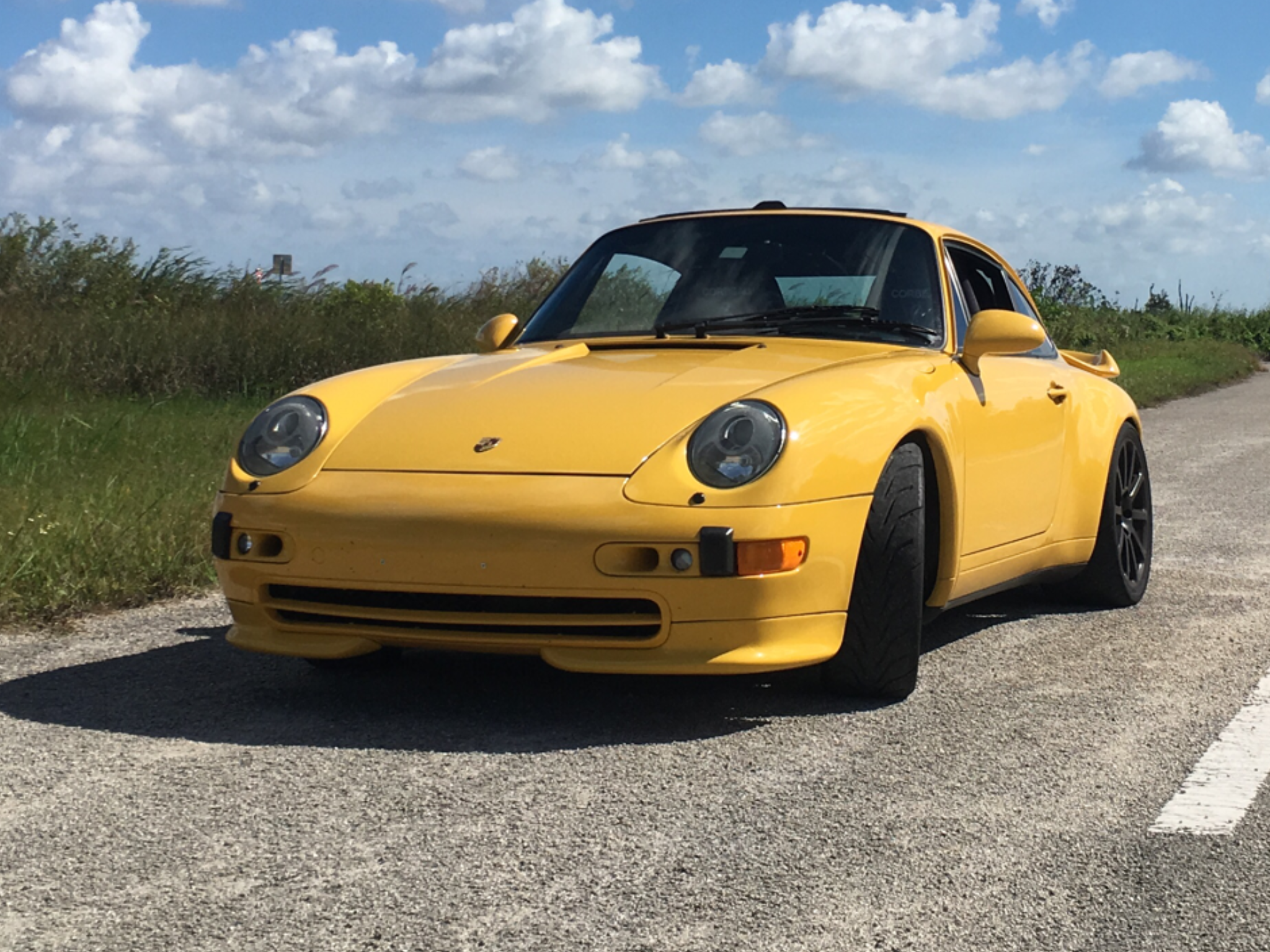
My dad’s old car, driven by yours truly back when we still had it. It’s a 1996 Porsche 911 Carrera, 993. It was modified back in the day to be a track weapon, with two massive turbos shoved in its wide rear end. The car made somewhere north of 450hp back in the day. It has no TC, no power steering, but did entertain the idea of driver aids with ABS.
Until I know what a Lotus, Ginetta, Caterham or an actual race car is like, this is it for me. No M car, modern Porsche, vette, AMG, Miata, brz/FRS, STI, z28… nothing has yet to compare to that car. It’s the standard I think back too when looking for how a car comunicantes to a driver, how rewarding a car is to drive, and how something can be both visceral and controlable.

So to start, it’s an air cooled 911. About 3000 lbs, small, smells very distinctly of leather and oil. A big tach stares back at you behind the wheel, displayed proudly before all other gauges. A mess of metal tubes live behind the seats, which are now outdated single molded buckets. The wheel is thin, but a bit large due to early airbag tech. You sit low, but have a great view from the comparatively large windscreen supported by two thin A-pillars. The hood slopes down to a point, with each fender acting as guides to help you place your front tires.
A heavily turbocharged flat six lives behind me, hung low behind the wide hips of the car, sending somewhere in the 400’s for horsepower to the rear wheels alone. When the car is cold, all you’ll hear is induction. The turbos spool and release, sounding a little like a diesel truck mixed with jet turbines as the car gets up to temp.

And once the oil is happy, you gun it. Lag is present but minimal, and the car comes alive. The induction noise is loud, but still can’t drown out the flat six wailing behind you as you go to grab another gear. The weight transfers to the rear, loading up the ass under acceleration, it grips, and you’re off to whatever speed this yellow bird wannabe cares to take you to.
The car spoke to you. Every input you gave it, it had a response for. The steering, weighty at low speeds, became a direct connection between where your mind wanted to go and where the car went. You knew exactly where the wheels where, how the road felt, and what the ass of the car wanted. It wonderfully presented the driver with every sensation and reaction physics needed to offer while not overwhelming your senses. And it doesn’t just end at dynamics either. The engine and transmission also spoke their own language back to you. When to let off, when it’s time to gun it, how much clutch and gas, the precise engagement of the gear lever. Everything was weighty, but everything gave you precise control and the best mechanical feeling I’ve found in a car.

So with the nostalgic circle jerk outta the way… what was this car really like to drive?
Raw. Angry. And a little terrifying for a while! This was the car I learned to drive stick on (You’re welcome to send your hate mail to Daytona, it makes good kindling for the fire pit)! The heavy controls paired with a severely inexperienced driver in a very yellow and loud Porsche made for an interesting combination. The clutch required the full force press of my , 15/16 year old legs, I couldn’t grasp the shifter, low speed corners required a lot of effort, and the lack of patience from the rest of the world when you stall made my teenage anxiety go through the roof.
But with time comes practice and familiarity. It was as much a lesson in learning to drive a manual car as it was one in understanding how a car communicates back to you in everyday driving. How much clutch, when to shift, what corner speed does it like, what’s its happy spot, how do you make the racing brakes SHUT UP (you don’t). You learn to read the reactions to your inputs, and grow confidence in both the car’s mechanical abilities and in your own driving. And you’re going to need confidence driving a car like this. Trust the grip and suspension, but never forget where that engine lives. That mass out back helps with corner exit. Also has lift off oversteer I learned. It’s controllable if you’re wondering.

By the end of our ownership of the car, I was driving it almost every other weekend. To birthdays, to friend’s houses, dates with my girlfriend at the time, or even just to drive. The car never lost that “specialness” the more I drove it. It just felt more right. And the car got attention. Right at the start of the hysteric aircooled 911 craze, the bright yellow fuck you to the 991 meandered around south Florida, getting waves, thumbs ups, pictures, people doing pulls by you, and a lot of stop light conversation. Older cars, especially German, seem to draw in that kind of attention (though not always the racing). And I’m well aware of the image that a high school kid in a bright yellow air cooled 911 has. But I think it’s in a separate room from the “dipshit in a wrx” that I would normally fall under. Cars like these should be seen and seen being driven.

So, I’ve been about 4 years removed from the little 993. It’s been sold off to a guy in Miami, who turned it into a gt2 replica and is continuing the legacy started by my dad by tracking it. Maybe an Elise will provide the same, if not better experience. I aim to get one once I’m outta college and stable in engineering. There’s something to said and sought after about a car that gets almost everything right (at least for what I value).
If you’re into cars, find something raw, a little unhinged, and most importantly communicative. Something that talks with you like no other car can. Be it a Miata, or an old 911, keep it as long as you can, enjoy every damn moment with it. Life is rarely laminar, and as fun as a bit of chaos and uncertainty is, you never know when it transitions to turbulence and you’re on a wild ride to god know where, and that car gets caught up in the wake.

Leave a Reply